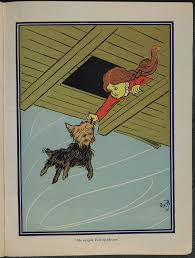
“No thief, however skillful, can rob one of knowledge, and that is why knowledge is the best and safest treasure to acquire.”
― L. Frank Baum, The Lost Princess of Oz*
Project Muse
"Full-text access to quality peer-reviewed journals in the fields of literature and criticism, history, the visual and performing arts, cultural studies, education, philosophy, political science, gender studies, economics, and many others" - University of Southern Mississippi Library database definition
"A Whole Book for a Nickel"? L. Frank Baum as Filmmaker
-
Children's Literature Association Quarterly is a publication offered gratis to members of the Children's Literature Association (ChLA). It is a scholarly journal pertaining to children's literature studies. The journal provides book reviews and peer reviewed articles in both scholarly and research aspects of children’s literature.
In this article Morey uses L. (Lyman) Frank Baum’s son Frank Joslyn Baum's biography to take a deeper look into his father’s original ventures into filmmaking from 1914-1915. Though Baum’s attempts were superior in many ways to other films being produced during this time period, unfortunately the film industry’s technology was a limiting factor to their success.
-
Morey, A. (1995). "A Whole Book for a Nickel"?: L. Frank Baum as Filmmaker. (4), 155-160. doi:10.1353/chq.0.1073.
Queer Utopianism and Antisocial Eroticism in L. Frank Baum’s Oz Series
-
Marvels & Tales is a journal whose peer reviewed works provide a platform for discussing Fairy Tales, written by scholars and researchers of varying backgrounds and disciplines including but not limited to psychology, gender studies, cultural history, anthropology film, music history and more.
Pugh here examines and takes the reader on a tour of the “queerness of” the utopian Land of Oz. Delving into the works’ non-typical gender roles, Pugh highlights its “queer eroticism.”
-
Pugh, T. (2008). “There lived in the Land of Oz two queerly made men”: Queer Utopianism and Antisocial Eroticism in L. Frank Baum’s Oz Series. (2), 217-239. https://www.muse.jhu.edu/article/258005.

Decoding L. Frank Baum's and W. W. Denslow's Wicked Witch of the West
-
The Great Plains Quarterly provides articles for interested scholars or individuals whose interests lie in all matters associated with the area that encompasses, and is known as, the Great Plains in the United States as well as Canada (Saskatchewan, Alberta, and Manitoba). It focuses on social issues, culture, history, and literature.
Radell’s article tackles the long-debated idea of whether or not The Wonderful Wizard of Oz is or is not an allegory. Using both Baum’s and W. Denslow’s ‘wicked witch’ in comparison to the ‘witch’ one finds in James J. Hill’s Biography, Radell pursues the non-allegorical angle.
-
Radell, W.W., Jr. (2018). Decoding L. Frank Baum's and W. W. Denslow's Wicked Witch of the West. (3), 273-293. doi:10.1353/gpq.2018.0042.
Home to Aunt Em: Sentimental Adoption in L. Frank Baum's The Wonderful Wizard of Oz
-
Children's Literature Association Quarterly is a publication offered gratis to its members of the Children's Literature Association (ChLA). It is a scholarly journal of children's literature studies. The journal provides book reviews and peer reviewed articles in both scholarly and research aspects of children’s literature.
In this article Taylor criticizes The Wonderful Wizard of Oz for its alleged non-acceptance of treating children as miniature adults. The author sees sentimentality as a failure on Baum’s part in his portrayal of Dorothy as an orphan.
-
Taylor, K.N. (2009). Home to Aunt Em: Sentimental Adoption in L. Frank Baum's . (4), 379-393. doi:10.1353/chq.0.1936.
Sympathy or Racism?: L. Frank Baum on Native Americans

-
Liguore looks back at the writings of Baum’s editorials and fiction in the context of the confusion of the time. Baum on one hand seems to be a supporter of the Native American plight, but some of his works seem to offer a side that could be taken to support racism. Liguore takes the reader through a look at Baum’s literary works as a man trying to understand and make sense of what is happening to the people around him in his rapidly changing and sometimes violent world. He also compares Baum’s work to that of Laura Ingalls Wilder taking into account the pervading thoughts of the day.
-
Liguore, H. (2017). Sympathy or Racism?: L. Frank Baum on Native Americans. Great Plains Quarterly 37(2), 77-82. doi:10.1353/gpq.2017.0017